Overview
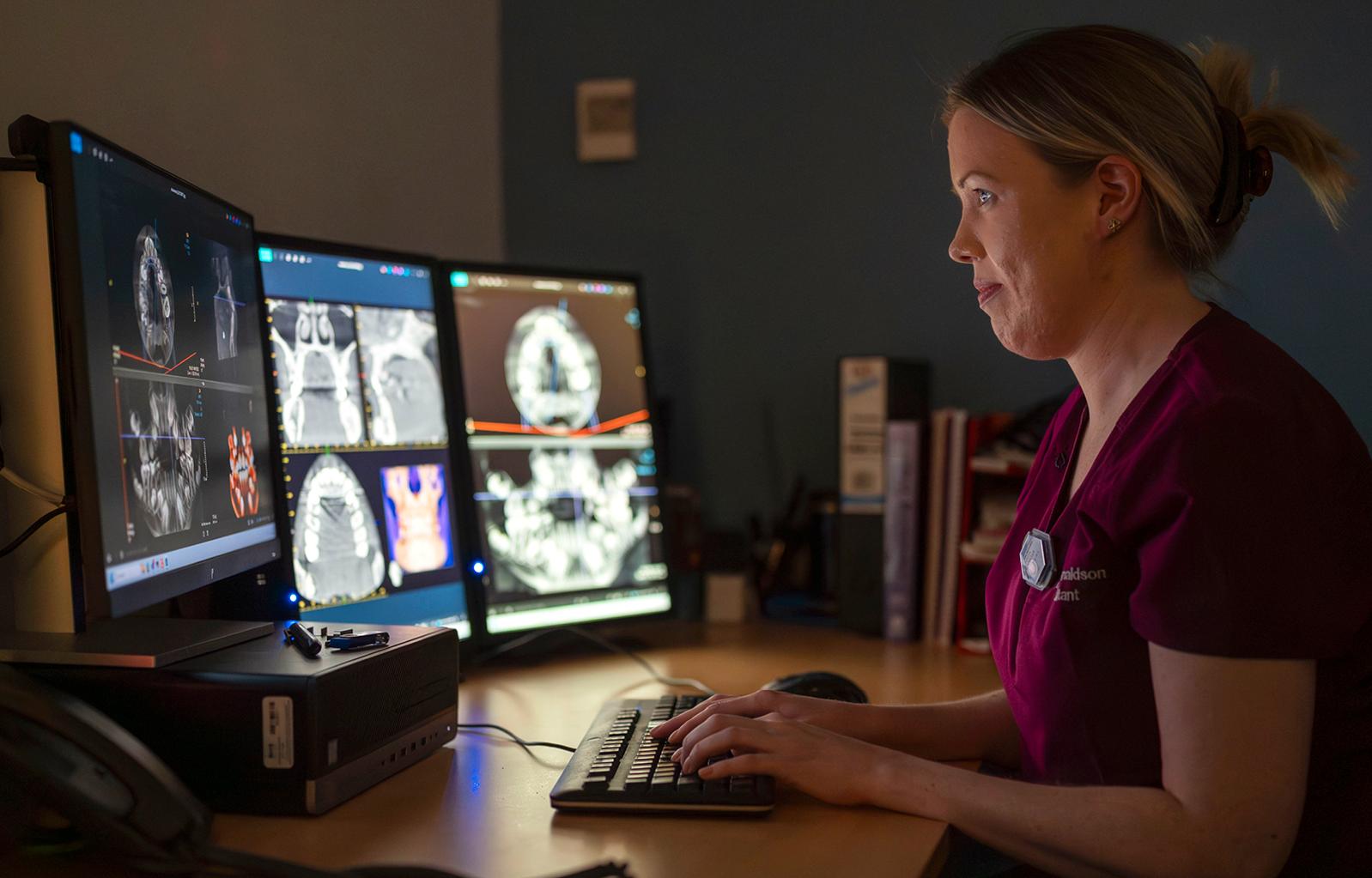
The programme combines hands-on practical training using CBCT software with expert-led teaching delivered by Consultants in Dental and Maxillofacial Radiology (DMFR). Delegates will have the opportunity to review and manipulate CBCT datasets under specialist supervision while developing a systematic approach to image interpretation and reporting.
This course is delivered in partnership with the British Society of Dental and Maxillofacial Radiology (BSDMFR). All teaching is provided by UK-based Consultants in Dental and Maxillofacial Radiology, and course content is subject to quality assurance by the BSDMFR.
This course provides 6 hours of verifiable CPD and meets the criteria for the General Dental Council's Enhanced CPD Development Outcome C.
Learning outcomes
By the end of this course, delegates will be able to:
- Identify the anatomical region demonstrated within a CBCT scan.
- Review the entire scanned volume using standard multiplanar reconstruction views (axial, sagittal and coronal).
- Optimise image viewing conditions through adjustment of brightness and contrast settings.
- Manipulate CBCT datasets, including reorientating images to align teeth in the correct anatomical position.
- Perform linear measurements using CBCT imaging, such as lesion dimensions.
- Generate curved multiplanar (panoramic) reconstructions and cross-sectional images.
- Recognise normal anatomy and common anatomical variations within the dento-alveolar region.
- Identify common incidental findings visible on CBCT examinations.
- Recognise common CBCT artefacts and understand their impact on image interpretation.
- Identify common pathological findings within the dento-alveolar region.
- Correlate findings on conventional radiographs with CBCT imaging.
- Apply a systematic approach to CBCT interpretation and produce structured radiological reports.
Who is this course for?
This course is designed for dentists and radiologists who wish to build upon the knowledge gained at Level 1 and develop competence in the interpretation of small-volume dento-alveolar CBCT examinations.
What happens on the day?
Click below to view the programme or download the pdf.
Important Information
- Delegates must have completed a CBCT Level 1 course before progressing to Level 2a.
- Delegates must have completed IR(ME)R training within the previous five years.
9.00
- Welcome & Overview of Day
9.10
- Lecture: Normal Anatomy of the Dentoalveolar Region on Cone Beam CT
9.50
- Hands-on demonstration: How to use the imaging software, manipulation of cone beam CT scan
10.00
- Break
10.30
- Review of cases
11.10
- Break
11.30
- Lecture: Radiolucencies
12.10
- Review of cases
12.50
- Lunch
13.30
- Review of cases
14.10
- Review of cases in pairs
14.50
- Break
15.10
- Delegates present case findings
15.50
- Lecture: Radiopacities
15.30
- Reflections, questions, and debrief
16.30
- Summary and Q&A session
17.00
- End of day
Attending the course
This event is an in-person course. That means you get the chance to join us in Glasgow.
At the College, you’ll benefit from state-of-the-art facilities, as well as lunch prepared by our award-winning chefs.
The Royal College of Physicians and Surgeons of Glasgow is conveniently located in Glasgow City Centre, within easy reach of major train stations, motorways and airports. Hotel and parking discounts can be accessed after booking.
Find out more about the best way to get to us.
Claiming your CPD
This course provides 6 hours of verifiable CPD and meets the criteria for the General Dental Council's Enhanced CPD Development Outcome C.
Gallery
Similar courses held at the College.
If you have any questions, feel free to contact the coordinator. Their details can be found below.