
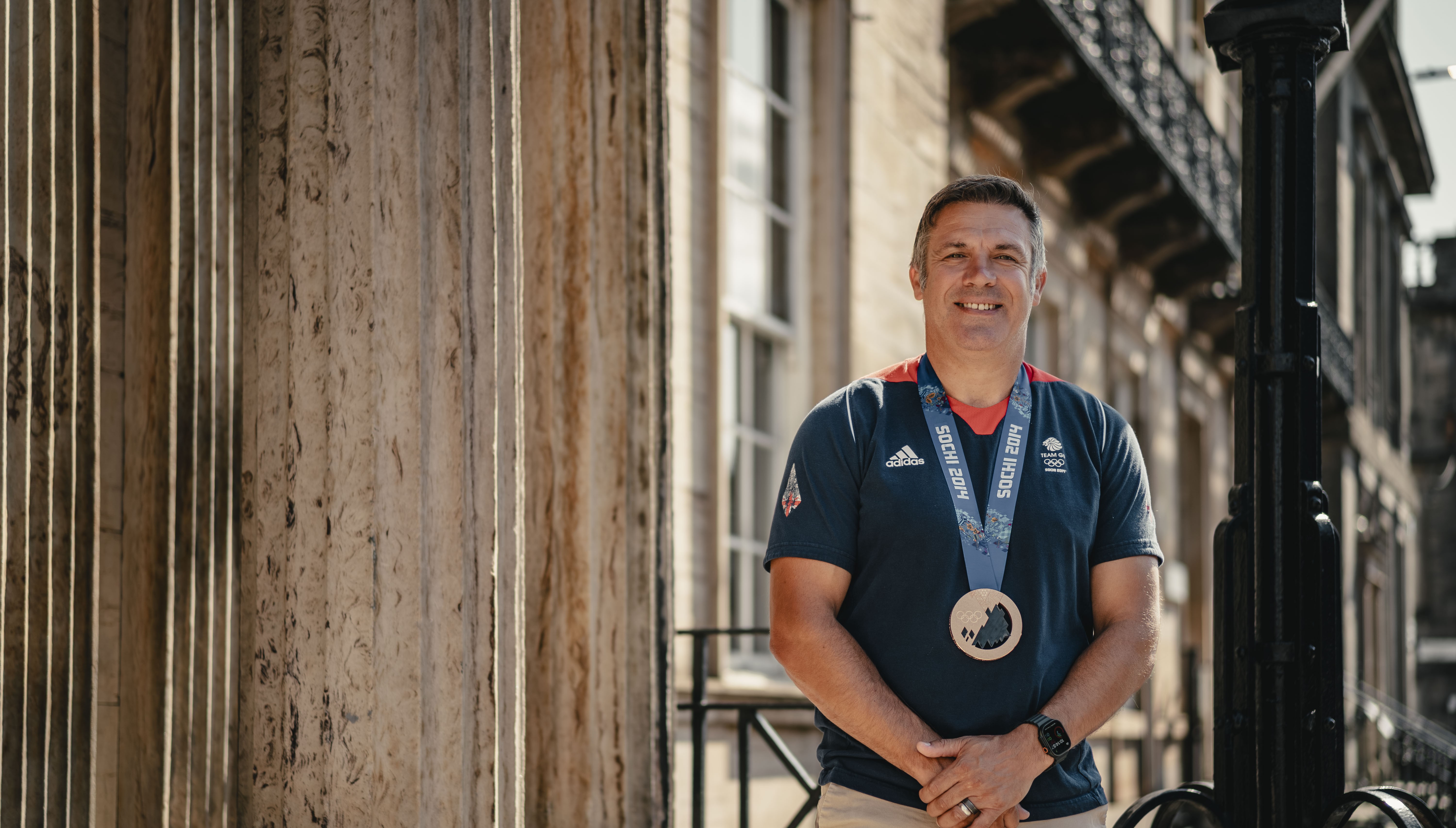
In 2013, British bobsleigh pilot John Jackson was flying high. "We’d come out of our best season, we’d just finished fifth at the World Championships and we were really building momentum towards the 2014 Sochi Olympic Games," he said.
"The trajectory was very, very good."
But on Saturday 13 July of that year, disaster struck. “We were doing a plyometric session - so we were jumping over hurdles, and sprinting for 10 or 15 metres.
"This was at the end of an eight-week training block. I was 36 at the time. I was fatigued. We’d pushed ourselves to the absolute limit because it was Olympic season.
"On the last rep of the day, I jumped over the last hurdle, I went to set off on the sprint and my right Achilles just exploded. After six or seven metres, I came to a stop.
"The pain was like being kicked in the calf. Because I’ve got a background in injury rehabilitation from the Marines, everything sort of clicked together. I did the calf squeeze test; there was no movement. I knew it was my Achilles.
"Everyone around me was in a panic – surely I was out. But I was in a sort of out-of-body-experience and feeling very calm. I was literally sitting on the track, already planning my rehab and how I could get to the Olympic Games in seven months."
The English Institute of Sport put John in contact with orthopaedic surgeon Professor Gordon Mackay, a Fellow of the College and a sports specialist based in Scotland, who was at the time pioneering a new internal brace technique to enhance healing and mobility.
"John had ruptured his Achilles tendon, the strongest tendon in the body," Professor Mackay said. “The question was how to manage this. Historically, we would have tied the ends of tendon together. But this strangles the blood supply, delays the healing, increases the risk of infection and re-rupture.
"With this new approach, we were working to preserve the biology and encourage healing. We were aware that we were pushing the boundaries with this new technology.
"Early results had been incredibly encouraging, but we had not yet done this procedure with an elite athlete. So John and I were on this journey together. As he was a rehab specialist, he led me through it, and the results were impressive.”
Four weeks after the operation, John had his first review. "I was really pleased with how [the surgery] had gone and I felt really comfortable, although I was probably a little bit tentative", he said. "We had this balance of pushing on as aggressively as the timeframe allowed us to, but against the natural instinct of the physios to allow things to heal. So there was a balance we had to get right."
.jpg)
By week 10, John had started sled testing. Just two weeks later, he ran for the first time following the operation.
"On my first run, I sort of hobbled through it, for no reason other than protecting the ankle. As I walked back, I gave myself quite a stern telling off.
"On my second run, I set off at 60 to 70% capacity and ran through it, and it felt absolutely fine. It was a very emotional moment.
"An hour after learning I would have this new surgery, I had told the team that we would still stand on the Olympic start line together. I was determined to hold myself accountable to that. So after my run, I burst into tears – it was such an emotional release.
"The physio appeared in an absolute panic, thinking I’d re-ruptured or injured something again. But the tears were because I was so pleased: at that point, I knew I was going to compete.
"Driving down a hill in a bathtub at 100 miles an hour was never an issue. But getting the rehabilitation right in such a short timeline? We only had one shot."
John went on to guide his crew to fifth place in the four-man event at the 2014 Winter Olympics, 0.11 seconds off a bronze medal. They were later upgraded to the bronze medal position after two Russian crews were disqualified for doping violations.
After more than a decade competing, John retired in 2016, but continues to work as a Marine. He told his story at our International Sports Surgery and Medicine Conference, which runs from Monday 20 July to Wednesday 22 July.